
What is measured, what is analyzed
Mikrofab Suite brings five major characterization families together in a single application: semiconductor/TFT/diode, photovoltaics, LCR/impedance, resonant acoustic spectroscopy and photodetector. A total of 37 measurement modes generate data from the instrument; 37 analysis modules extract physical metrics from the file you load. Every number comes from a single pure core; measurement, batch processing and the Analysis workspace always return the same result. A value that cannot be computed is never filled with 0 — it is shown as “missing” (—).
Transistor, diode and resistivity characterization
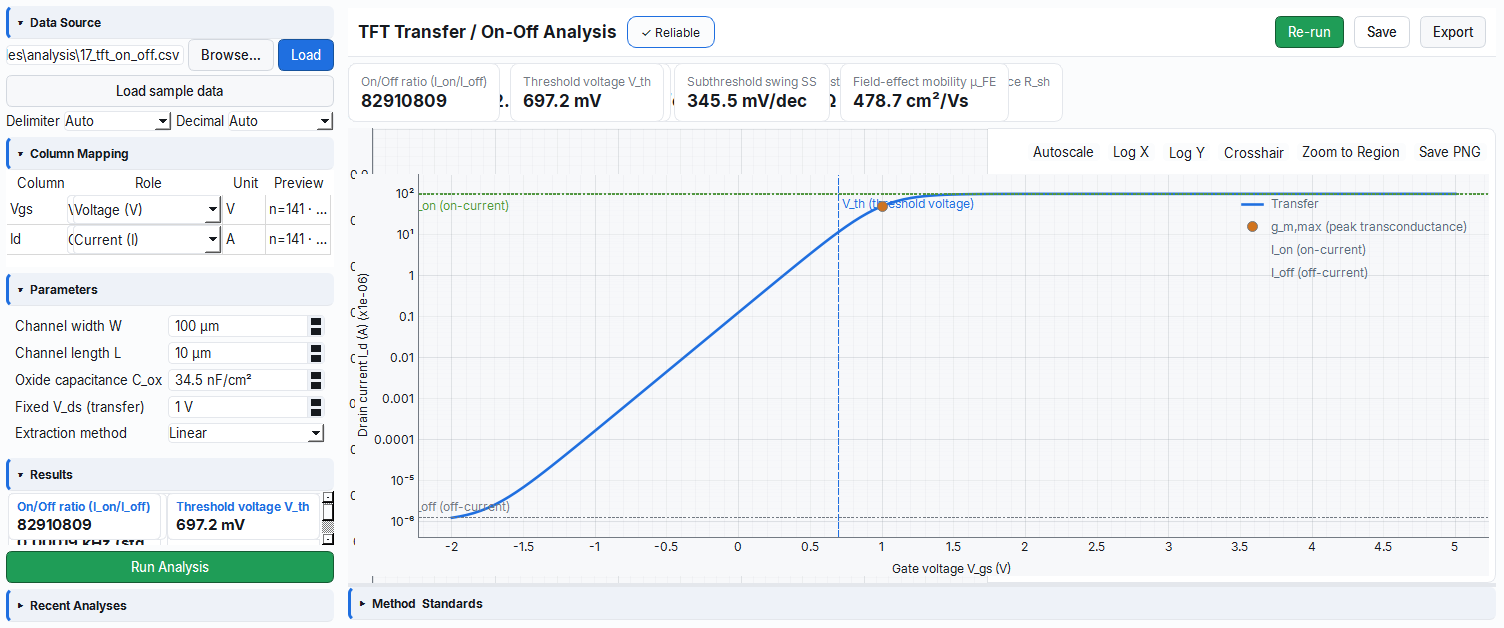
A broad family ranging from transfer (Id–Vg) and output (Id–Vd) sweeps to pulsed I-V, hardware-fast sweeps, diode/Schottky I-V, reverse recovery, four-point resistivity, van der Pauw/Hall, Kelvin 4-wire and temperature-dependent I-V. Threshold voltage is computed by peak-gm tangent extrapolation (IEC 60747 line), subthreshold swing from the steepest decade window, and mobility with optional geometry (W, L, Cox).
- Transfer / on-off. Vth, SS, µFE/µsat, Ion/Ioff, gm,max, Y-function µ0/Vth,Y, interface trap density Dit and hysteresis ΔVth in dual sweeps.
- Output family. Ron, output resistance ro, channel-length modulation λ, Early voltage VA, knee voltage and intrinsic gain Av.
- Diode / Schottky. Ideality factor n, saturation current I0, series/shunt resistance Rs/Rsh, rectification ratio RR, Schottky barrier height ΦB and saturation current density J0.
- Reliability & mapping. Bias-stress ΔVth/MTTF, SET/RESET endurance window and wafer heat-map uniformity.
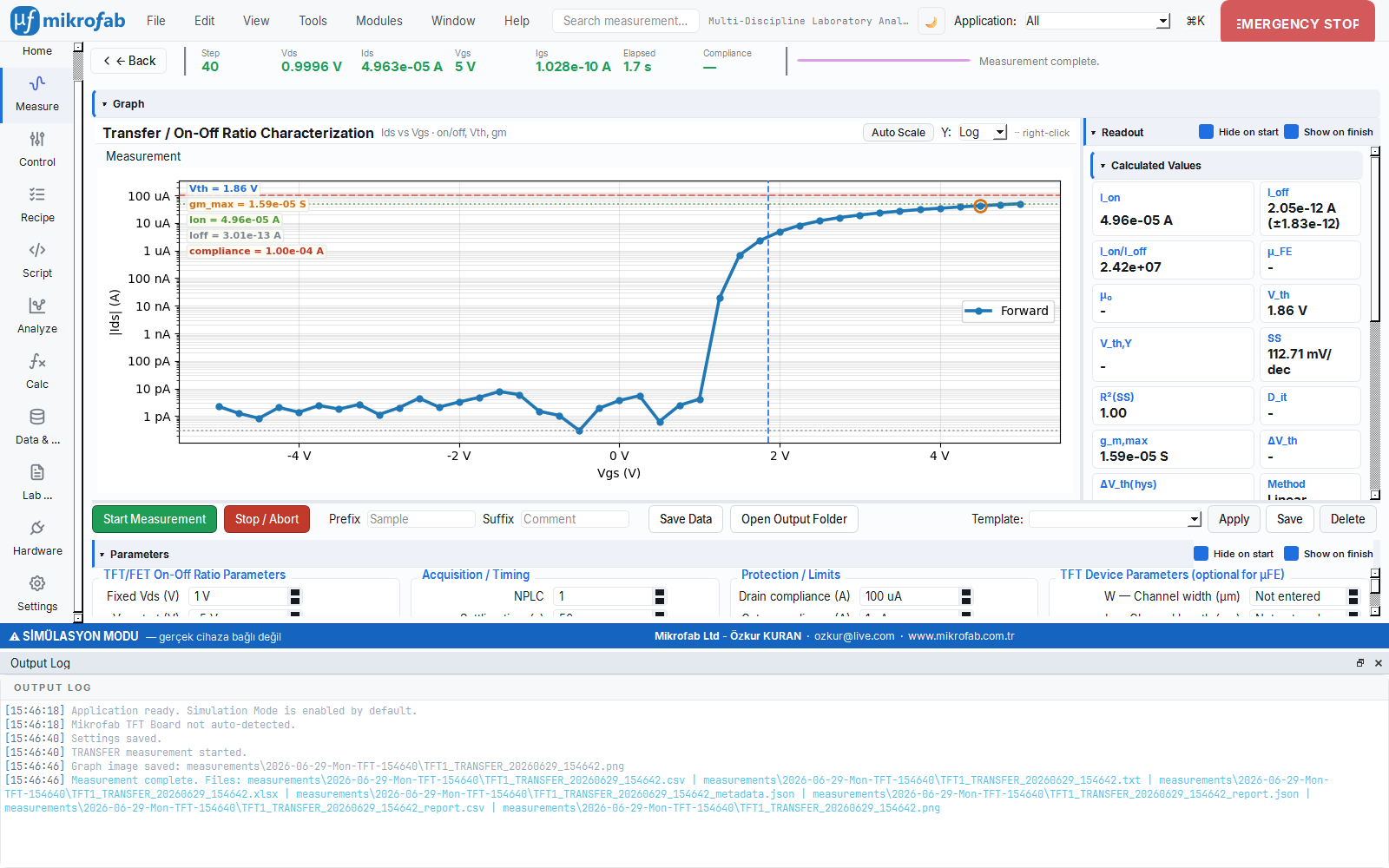
| Metric | Symbol | Unit | Method / Basis |
|---|---|---|---|
| Threshold voltage | Vth | V | Peak-gm tangent extrapolation (IEC 60747) |
| Subthreshold swing | SS | mV/dec | Steepest ~1 decade window; 300 K physical limit ≈ 59.5 mV/dec |
| Field-effect mobility | µFE / µsat | cm²/Vs | From gm,max or √IDS slope (with W, L, Cox) |
| On/off ratio | Ion/Ioff | — | Noise-robust off median; typically ~10⁸ |
| On-resistance | Ron | Ω | Inverse of the low-VDS linear-region slope |
| Ideality / saturation current | n · I0 | — · A | ln(I)–V fit, shunt-corrected (Shockley) |
| Schottky barrier | ΦB | eV | Thermionic emission; Richardson plot in T-IV |
J-V performance and stability metrics
With light/dark/hysteresis/pulsed J-V, Suns-Voc, irradiance sweep, MPP tracking, light soaking, bias-stress, degradation and thermal-stress modules, it characterizes a solar cell, mini-module, perovskite or silicon test structure end to end. All performance metrics are produced from a single core (Spec v2.0); irradiance is entered manually (STC = 1000 W/m², AM1.5G) and active area is mandatory for PCE. The sign convention is detected automatically from the power-quadrant integral.
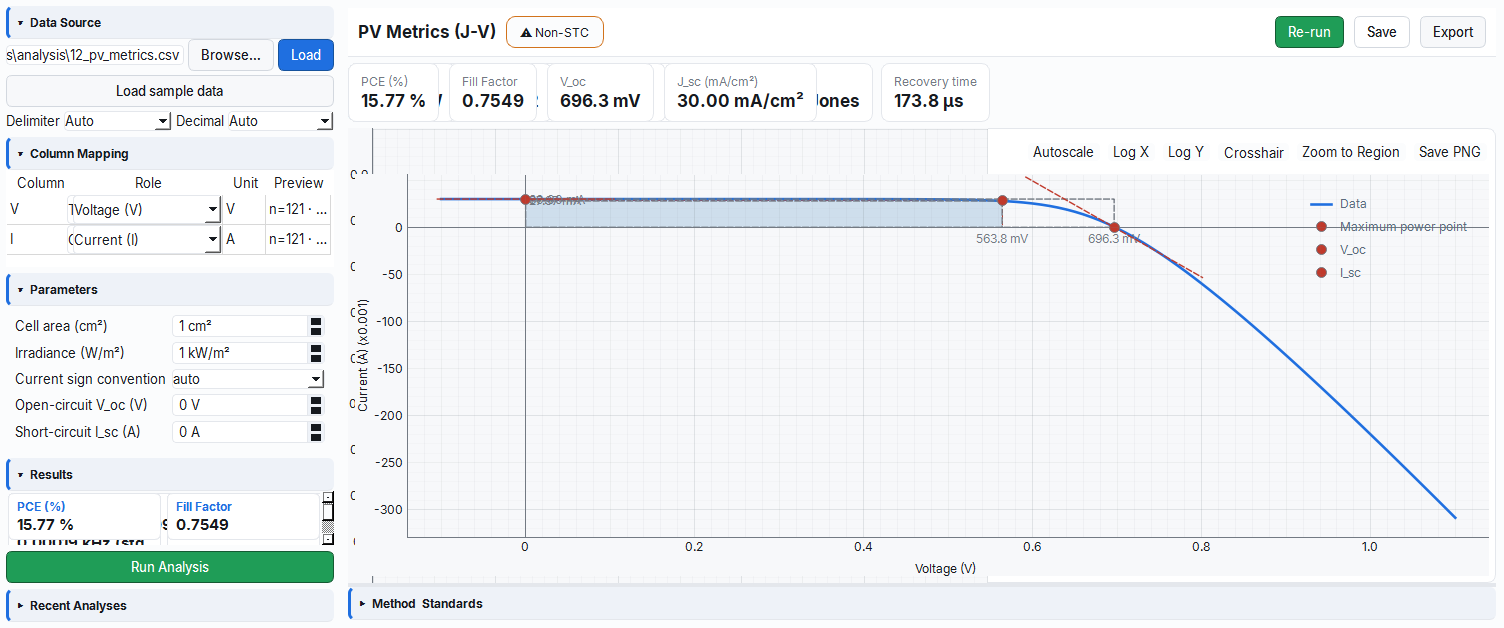
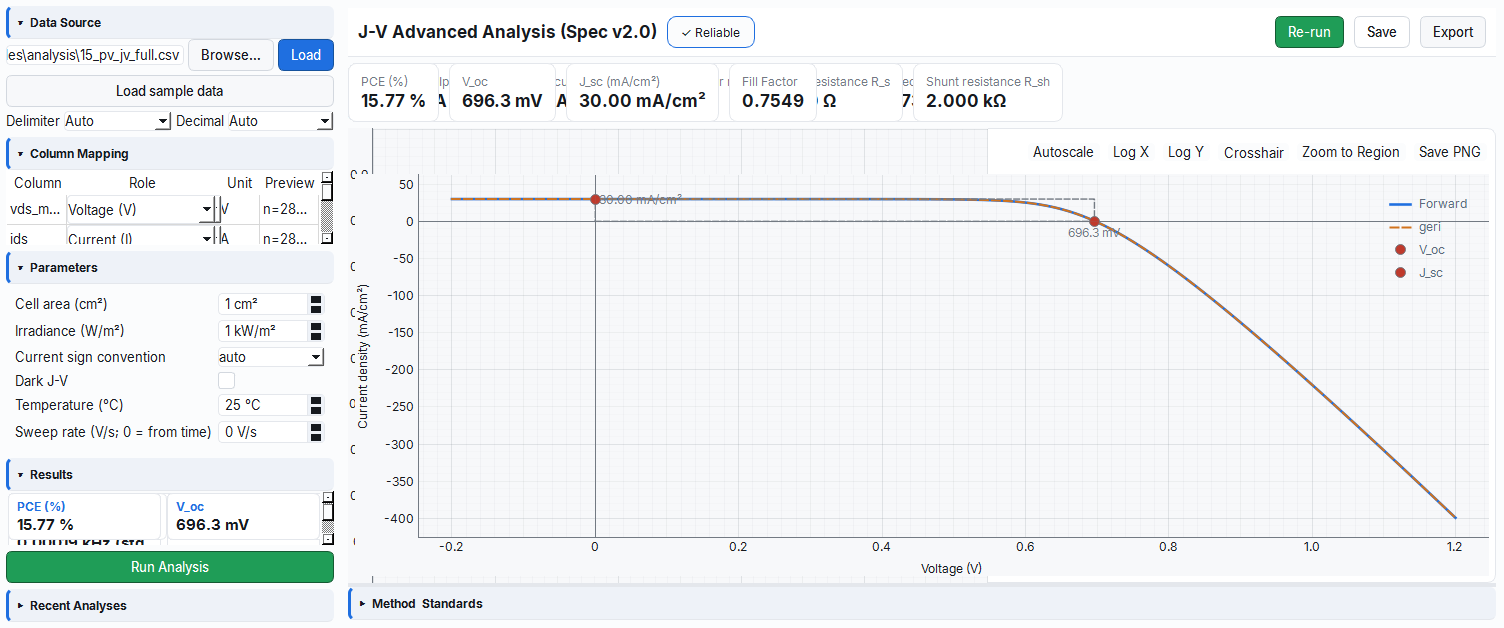
- Core J-V. Voc, Jsc, Vmpp, Pmax, fill factor FF, efficiency PCE and window-fitted series/shunt resistance Rs/Rsh (with reported R²).
- Hysteresis. HI = (PCErev − PCEfwd) / PCErev and an area-based hysteresis index — an indicator of ion migration/trapping in perovskites.
- Stability & aging. Retention (%), T80/T90 lifetime thresholds (ISOS 2020), MPP stability and temperature coefficients dVoc/dT, dPCE/dT.
- Advanced analysis. Suns-Voc ideality factor n, irradiance linearity (Jsc–suns R²) and apparent capacitance / scan-rate dynamics.
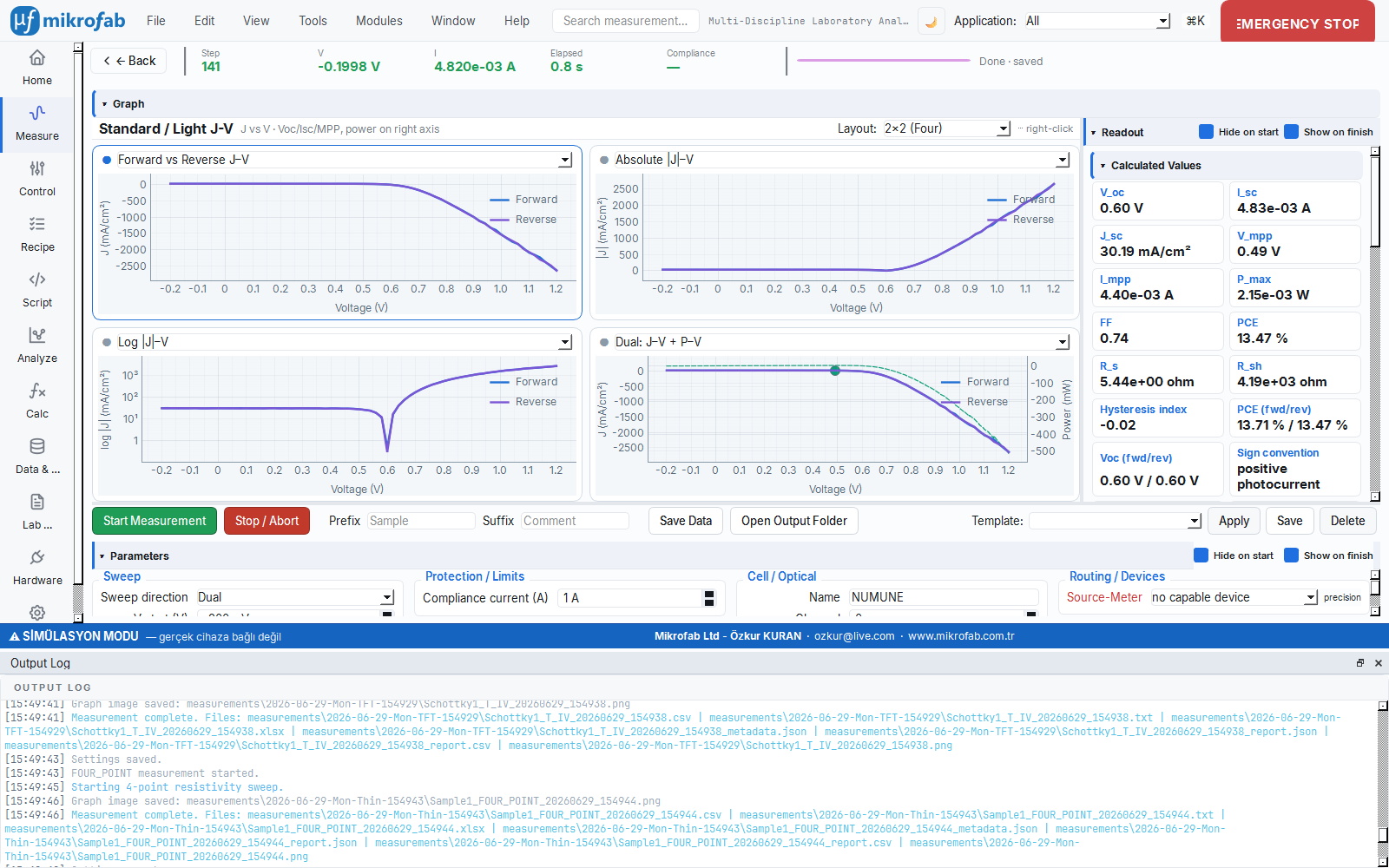
Voc · Jsc · FF · PCE
Open-circuit voltage is taken from the persistent first zero crossing of the current, short-circuit current density from V=0 interpolation, fill factor as Pmax/(Voc·Isc) and efficiency as Pmax/Pin.
Rs · Rsh
Series resistance is extracted by linear fit in the [Voc, Voc+0.05 V] window and shunt resistance in the V=0 ± 0.05 V window; if the window is insufficient it falls back to the local slope.
Retention · T80 / T90
From light-soaking and degradation runs, the retained percentage relative to the start and the time to first reach 80%/90% of PCE (linear interpolation, exponential extrapolation if needed).
C-V, Mott-Schottky and impedance spectroscopy
The LCR/impedance workstation gathers four measurement modes in a single form: capacitance–voltage (C-V), capacitance–frequency (C-f), impedance spectroscopy (Z-f, Nyquist) and temperature-resolved admittance (TAS). Every point carries the raw complex impedance; the readout panel derives parallel-equivalent-circuit quantities (Cp, Rp, Gp, loss factor D, quality factor Q) live. On the analysis side, eight expert modules (A1–A8) extract the device physics.
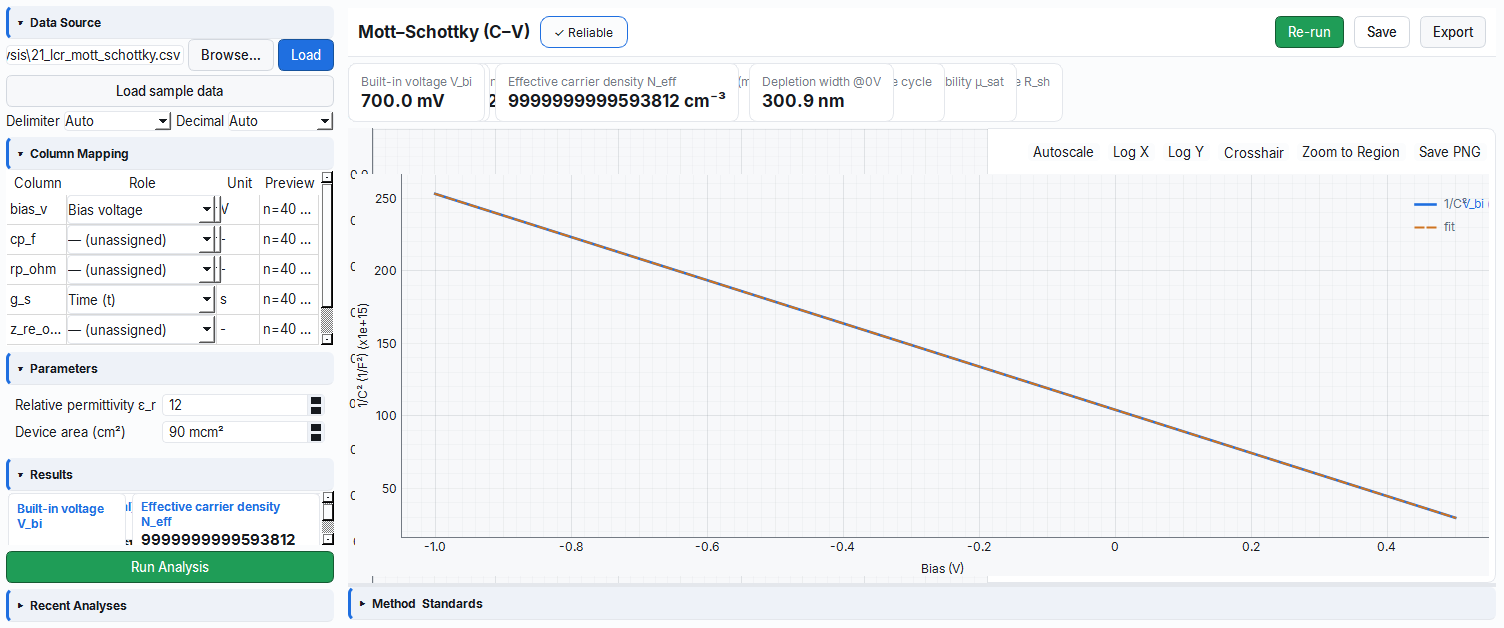
- Mott-Schottky (C-V). Effective carrier density Neff from the 1/C²–V slope, built-in voltage Vbi from the x-intercept and depletion width Wd.
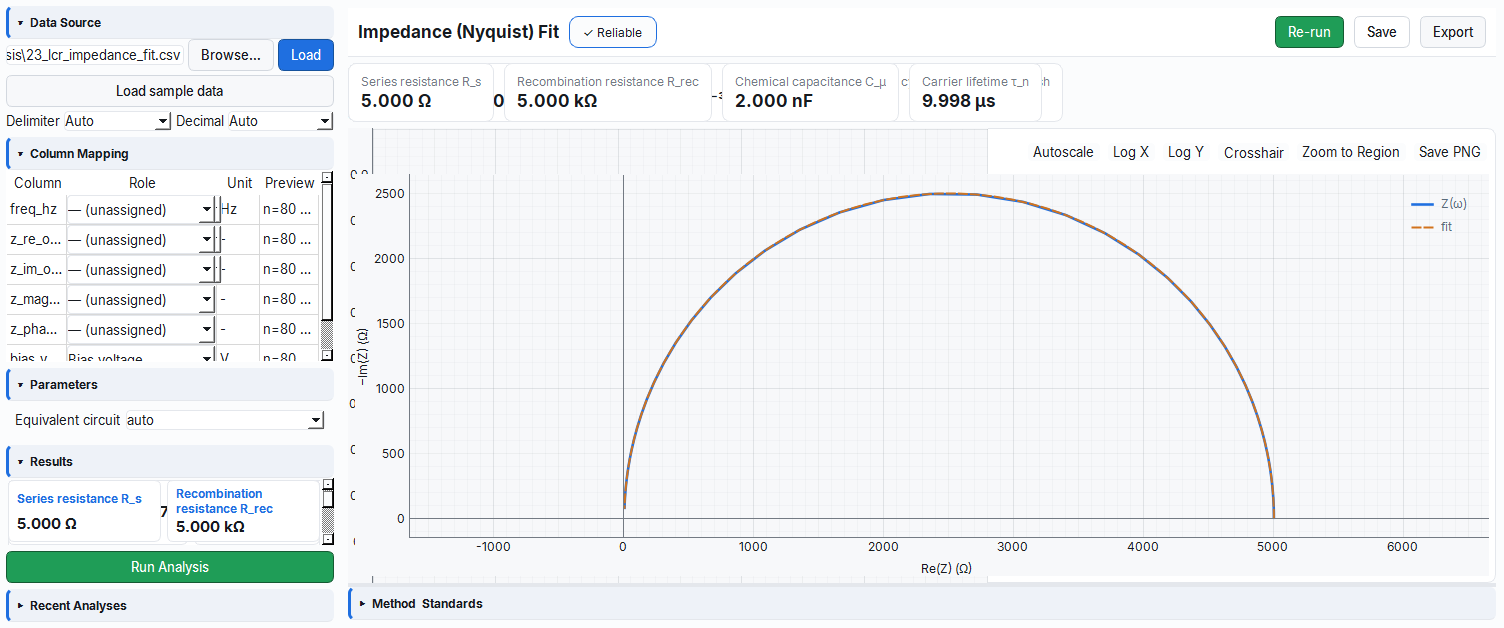
- Impedance fit (Z-f). Rs, Rrec, Cµ and recombination carrier lifetime τn = Rrec·Cµ via a complex NLLS fit of a Randles-type equivalent circuit.
- Trap spectroscopy. Threshold emission frequency f₀ from the C-f Debye step, Walter trap-DOS + Urbach energy EU and interface trap density Dit from the admittance method.
- TAS Arrhenius. Trap activation energy EA and attempt frequency ν₀ from the temperature-resolved admittance stack.
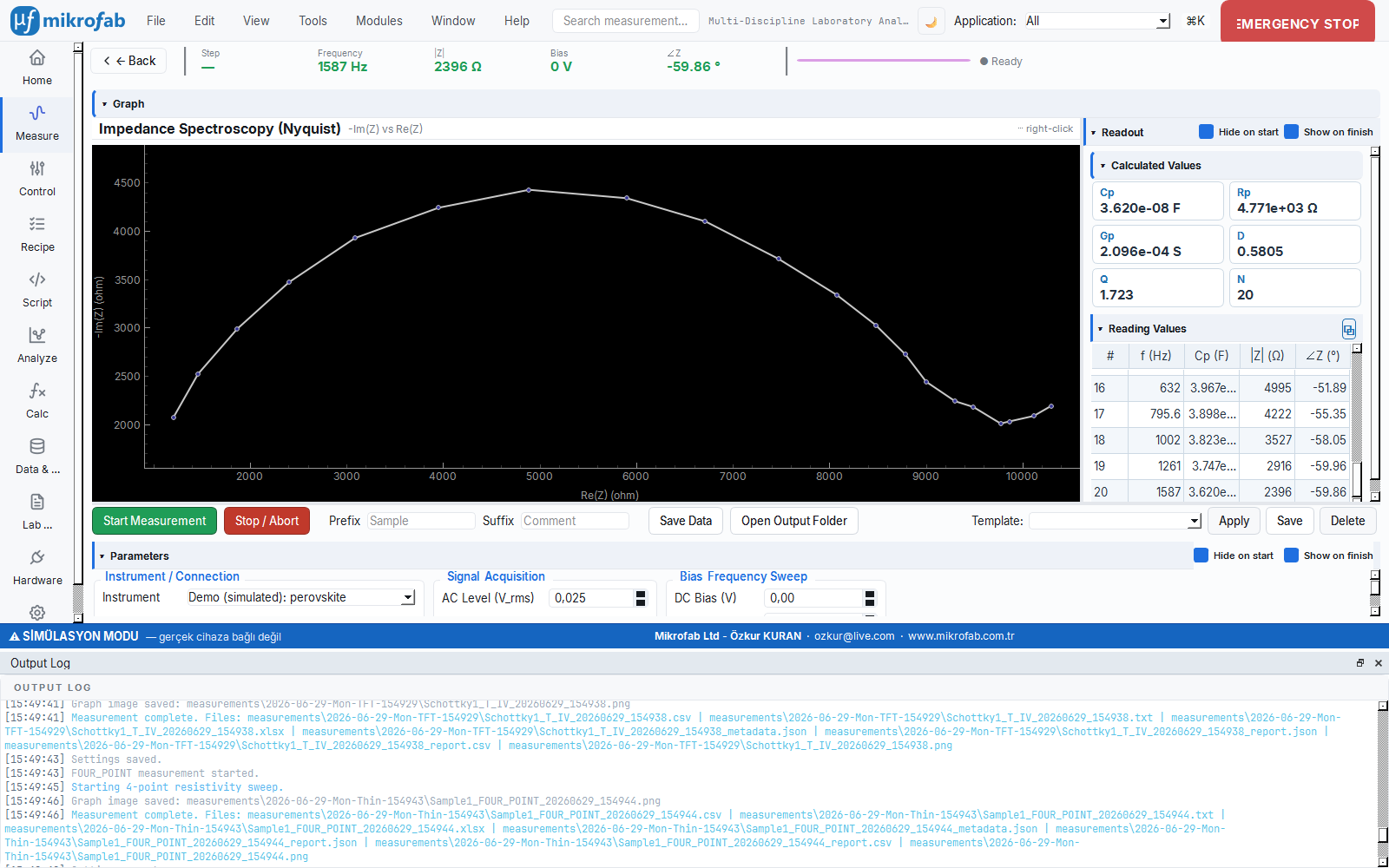
Neff · Vbi · Wd
At a sharp junction the 1/C² quantity is linear in bias; the slope gives carrier density and the intercept gives built-in voltage. Uncertainty is propagated with GUM covariance.
Rrec · Cµ · τn
Fit to the Nyquist spectrum with automatic equivalent-circuit selection (by device type); recombination resistance, chemical capacitance and carrier lifetime from a single source.
f₀ · EU · Dit · EA
Full trap characterization via C-f Debye relaxation, trap-DOS + Urbach band tail, the Nicollian–Brews conductance method and TAS Arrhenius analysis.
Resonance, quality factor and elastic tensor
The resonant piezo/acoustic spectroscopy (RPS) workstation scans mechanical resonance by sweeping the drive frequency, using a lock-in amplifier, an oven controller and a sample thermometer. It supports harmonics, temperature and stress as axes. At the end of a run a Lorentzian is fitted to the 1f spectrum; the analysis family (29–35) extracts resonances, acoustic damping, relative elastic modulus and the full elastic tensor (Cij) from it.
- Lorentzian fit. Resonance frequency f₀ (kHz), quality factor Q = f₀/FWHM, line width FWHM and peak area (∝ d₃₃ piezo coefficient).
- Temperature-resolved. Acoustic damping Q⁻¹ ∝ FWHM(T), relative d₃₃, relative elastic modulus (f₀² ∝ ceff/ρ) and nonlinearity ratio (Xf/1f).
- Multi-mode (RUS). Complex (X/Y) two-pole fit to all resonances in the sweep; removes feedthrough-induced Fano asymmetry and gives unbiased f₀/Q.
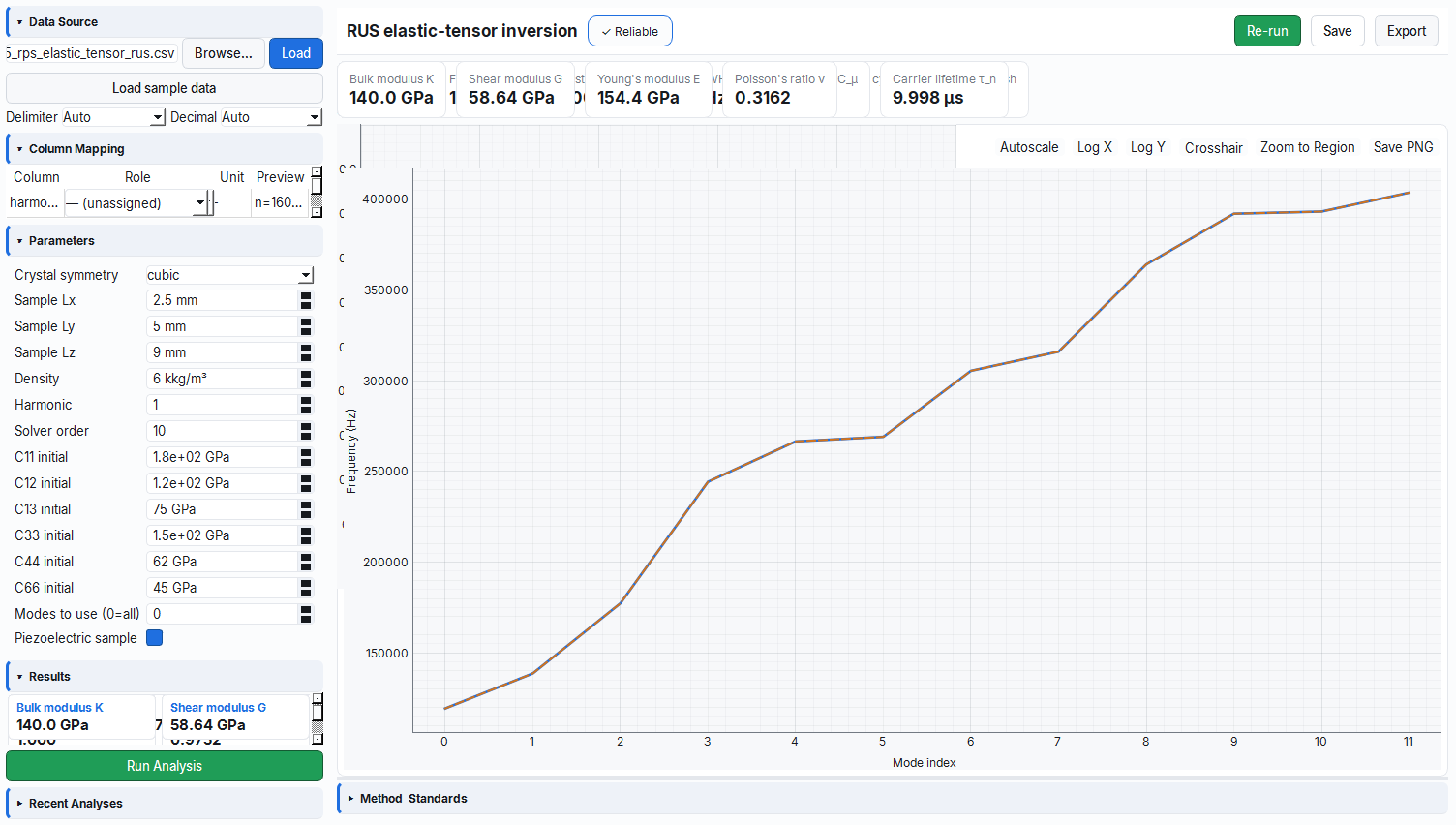
- Elastic tensor inversion. The independent Cij constants of the chosen crystal symmetry from a sample of known geometry + Voigt–Reuss–Hill aggregate moduli (K, G, E, ν) and Zener anisotropy.
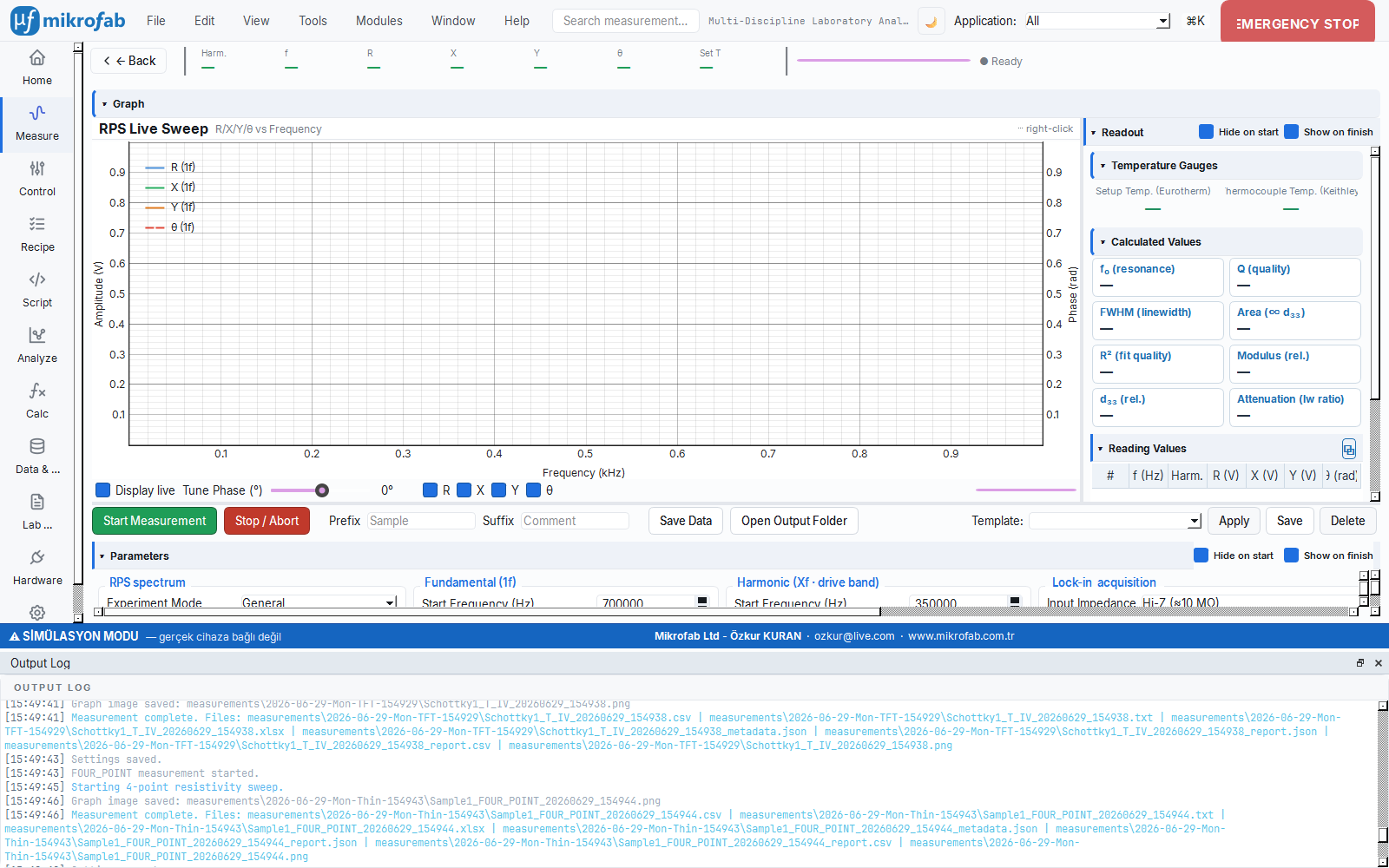
f₀ · Q · FWHM · Area
Resonance frequency, quality factor, half-height line width and peak area from a high-Q Lorentzian fit; uncertainties are propagated with GUM from the fit covariance.
Cij · K, G, E, ν
Independent elastic constants are inverted from the measured multi-mode spectrum via the Rayleigh–Ritz / Visscher forward problem; five symmetry classes from isotropic to orthorhombic.
Modulus · d₃₃ · damping
By tracking f₀², peak area and FWHM with temperature: elastic softening, relative piezoelectric response and anelastic loss; clearly reveals phase transitions.
Responsivity, EQE, D* and rise time
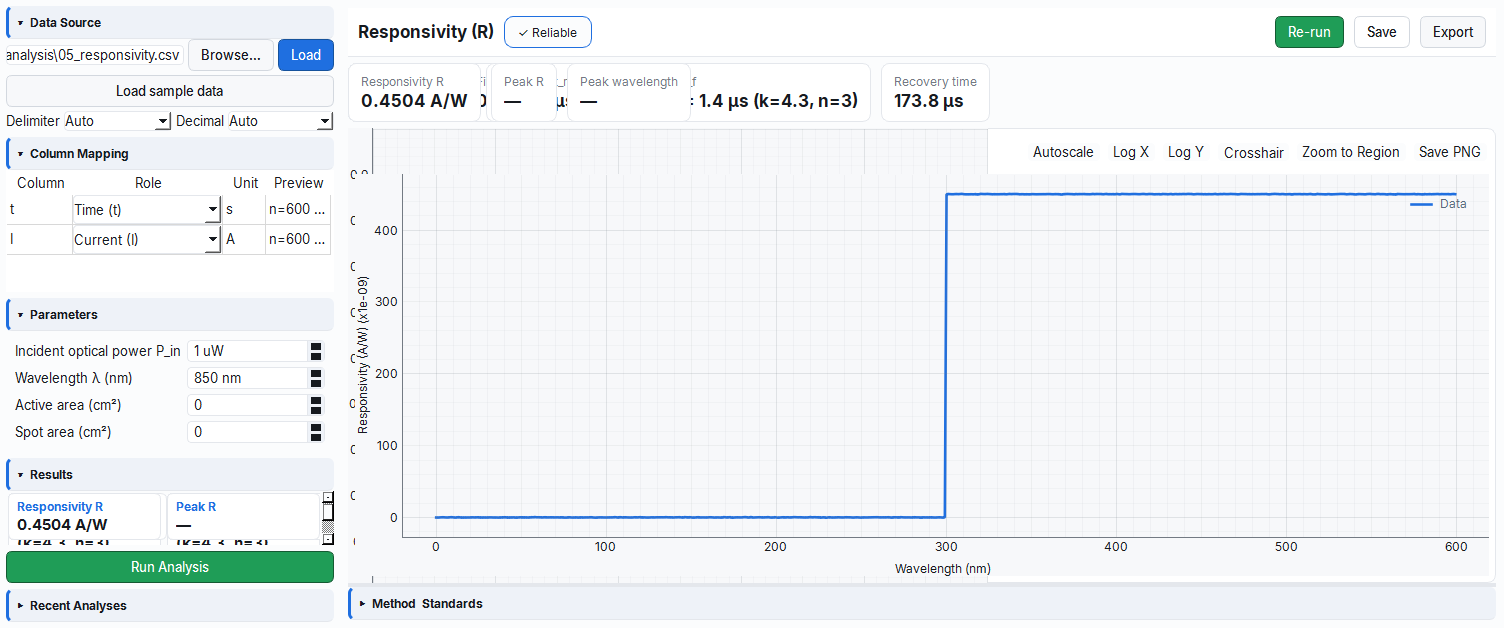
The photodetector analysis family (Modules 1–10) extracts a complete performance package from photo-switching time series and dark-current noise. From spectral responsivity to quantum efficiency, from noise-equivalent power to specific detectivity, every metric is presented with its standard reference and a reliability badge. Roles are mapped automatically; files from different instruments are computed without manual mapping.
- Spectral responsivity. Responsivity R = Iphoto/Pdet [A/W] and implied EQE = R·1239.84/λ; an R(λ) curve if a wavelength table is available (IEC 60904-8).
- Quantum efficiency. External (EQE) and internal (IQE = EQE/(1−Rrefl)) quantum efficiency; a gain-suspicion warning when exceeding 100%.
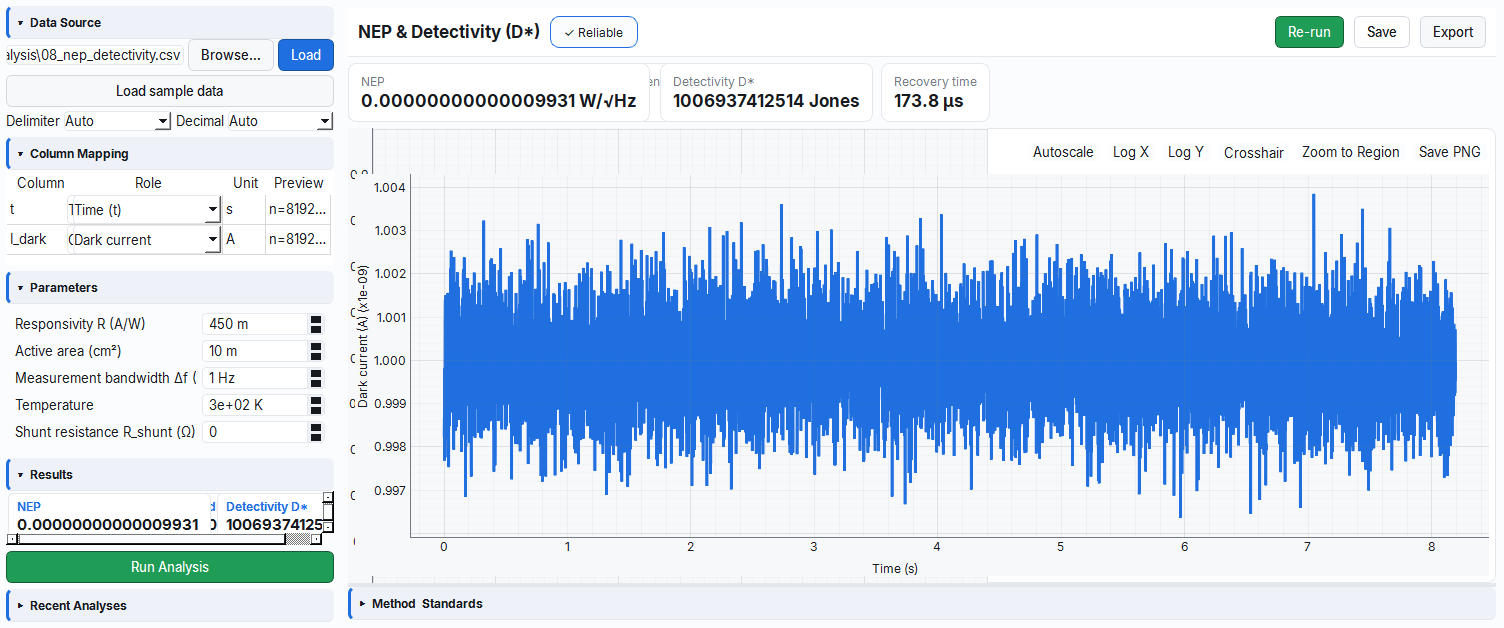
- Noise & detectivity. NEP [W/√Hz], specific detectivity D* [Jones], dominant-noise (shot/thermal) discrimination and the 1/fγ corner frequency from the noise PSD.
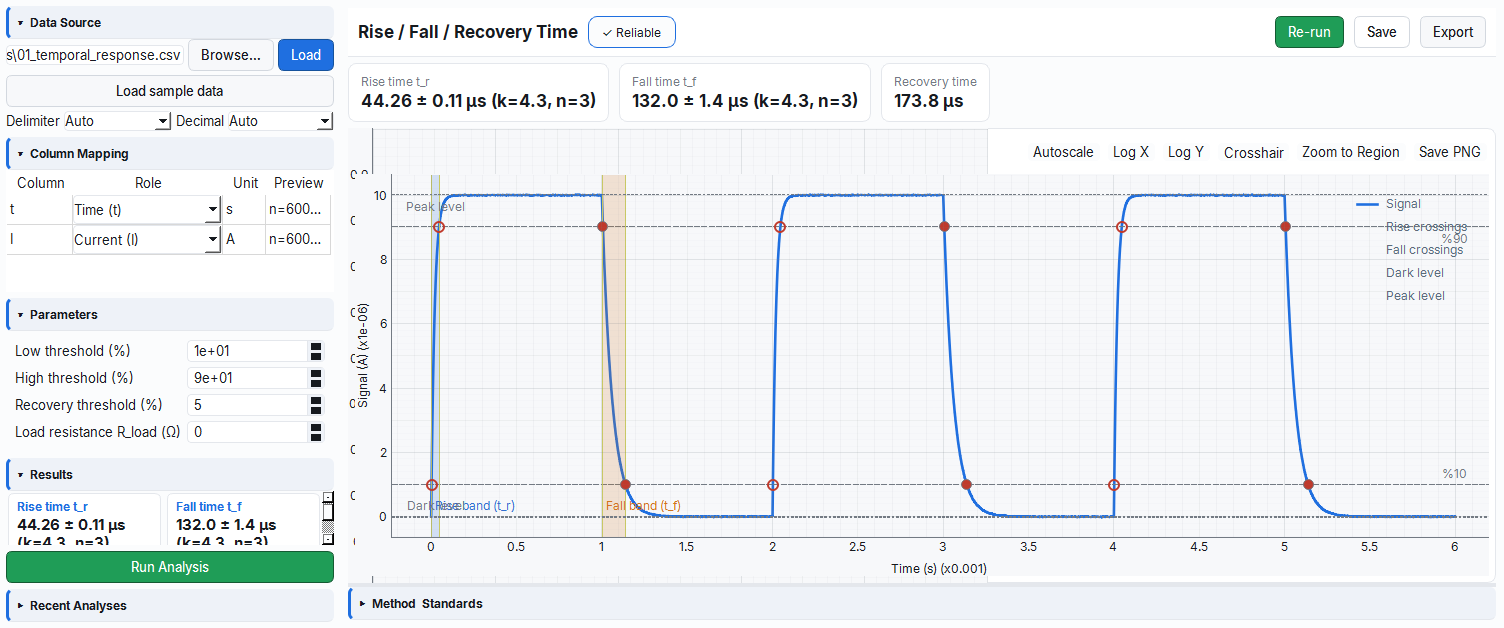
- Temporal response. Rise/fall/recovery times (IEEE 181, IEC 60469), -3 dB bandwidth BW = 0.35/tr, photo/dark ratio, SNR and linear dynamic range LDR.
| Metric | Symbol | Unit | Formula / Method |
|---|---|---|---|
| Spectral responsivity | R | A/W | Iphoto / Pdet |
| External quantum efficiency | EQE | % | R · 1239.84 / λ[nm] |
| Specific detectivity | D* | Jones | R · √(A·Δf) / inoise |
| Noise-equivalent power | NEP | W/√Hz | noise density / R |
| Rise time | tr | s | 10% → 90% transition (IEEE 181) |
| -3 dB bandwidth | BW | Hz | 0.35 / tr |
| Linear dynamic range | LDR | dB | 20·log₁₀(Pmax/Pmin); power law α (IEC 60904-10) |
Extracted metrics, real analysis screens
Every analysis module is validated against a physics-based synthetic “ground truth” data set; the numbers in the manual are reproducible bit for bit in the product. The screens below were produced with the shipped sample data sets.
Get started with training, the manual and examples
Don't just read about the capabilities; run your own measurement in simulation mode, load the shipped sample data sets into the Analysis workspace and learn the physics behind every metric with the step-by-step manual.
R&D and production laboratories
- Bring five families to a single bench and tie them to a traceable, sealed report
- High-volume scanning across the wafer with a Switch Matrix + recipe
- A reliability gate with bias-stress, endurance and degradation
- A record ready for audit and accreditation with standard-cited outputs
Researchers, students and education
- Risk-free learning and classroom demos with hardware-free simulation mode
- Correct methodology with GUM uncertainty + reliability badge
- Reproduce every metric with validated sample data sets
- Advanced characterization techniques from Mott-Schottky to the elastic tensor
User manual
Measurement and analysis catalogs, formulas and standard bases, step by step. A separate section for each family.
Open the manualAcademy
Method-based training content: Vth extrapolation, fill factor, Mott-Schottky and more.
Go to the AcademySolutions
Which measurement family for which instrument/material? Capability mapping by application scenario.
See the solutionsTry the capabilities with your own data
Mikrofab Suite runs without hardware in simulation mode; you can explore all 37 measurement modes and 37 analysis modules right up to installation. Request a personalized demo or start right away with the manual.